
TL;DR: An evening shutdown ritual is a 5-minute, 3-step end-of-day routine—Clear, Migrate, Sign Off—that leverages the Zeigarnik effect to quiet work thoughts at night. You don't need to finish every task to disconnect; you only need to give unfinished items a trusted, specific destination for tomorrow.
An evening shutdown ritual is a short, repeatable end-of-day routine, usually under five minutes, where you review what you finished, decide what happens to everything you didn’t, and consciously sign off for the day.
Its purpose is to close the mental “open loops” that keep your brain replaying unfinished tasks long after you’ve stopped working. Done consistently, it’s the single most reliable way to stop thinking about work at night.
If your laptop lid closes but your head stays at the "office", rehearsing tomorrow’s to-do list at 11 p.m., waking up already behind, the problem usually isn’t your workload. It’s that your workday never actually ended. It just paused.
This is the evening companion to a solid morning routine.. Where a 5-minute morning reset tells your brain what to focus on, the shutdown ritual tells your brain it’s safe to stop.Together, they give the workday a clean start and a clean finish instead of one long, blurry stream.
Key Takeaways: The 3-Step Evening Shutdown
- Clear the Queue: Audit the day to separate completed tasks from open ones, giving your brain immediate closure on what got done.
- Migrate the Rollover: Assign every unfinished task a specific time and destination (tomorrow or backlog) to trigger intention offloading and stop intrusive work thoughts at night.
- Sign Off: Complete a deliberate physical end signal: reflect on the day, declare work is finished, and close your workspace, to officially switch your nervous system into off-hours mode.
The Cognitive Trap: Why Unfinished Tasks Follow You Home
There’s a specific reason a half-finished task nags at you more than a completed one. It’s called the Zeigarnik effect, named after psychologist Bluma Zeigarnik, who first demonstrated it experimentally in 1927.1 The idea reportedly began with an observation in her mentor Kurt Lewin’s research group: waiters remembered unpaid orders in vivid detail... and forgot them the instant the bill was settled.
The principle: your brain holds open, incomplete tasks in a state of active tension, and keeps surfacing them until they're either finished or consciously deferred. That tension is useful during the workday; it's what keeps you from forgetting things. But it doesn't have an off switch. At night, this exact mechanism becomes a primary driver of work anxiety or worry at night, repeatedly surfacing a mental checklist of everything you didn't get to.
The crucial detail most people miss: you don’t have to finish a task to release the loop. You only have to give it a trusted, specific home.
A 2011 study by Masicampo and Baumeister found that simply making a specific plan for an unfinished goal, such as deciding when and where you’ll deal with it, largely eliminated the intrusive thoughts that goal would otherwise cause. The brain trusts the plan and lets go.
That’s the entire mechanism a shutdown ritual exploits. You’re not doing more work at 6 p.m. You’re telling your mind, task by task, “This is handled! You can put it down.”
The 3-Step Shutdown Framework
A good shutdown ritual has three moves; the whole point is that it’s short enough to actually do every single day, and not become yet another chore.
Step 1 — Clear the queue (review what happened)
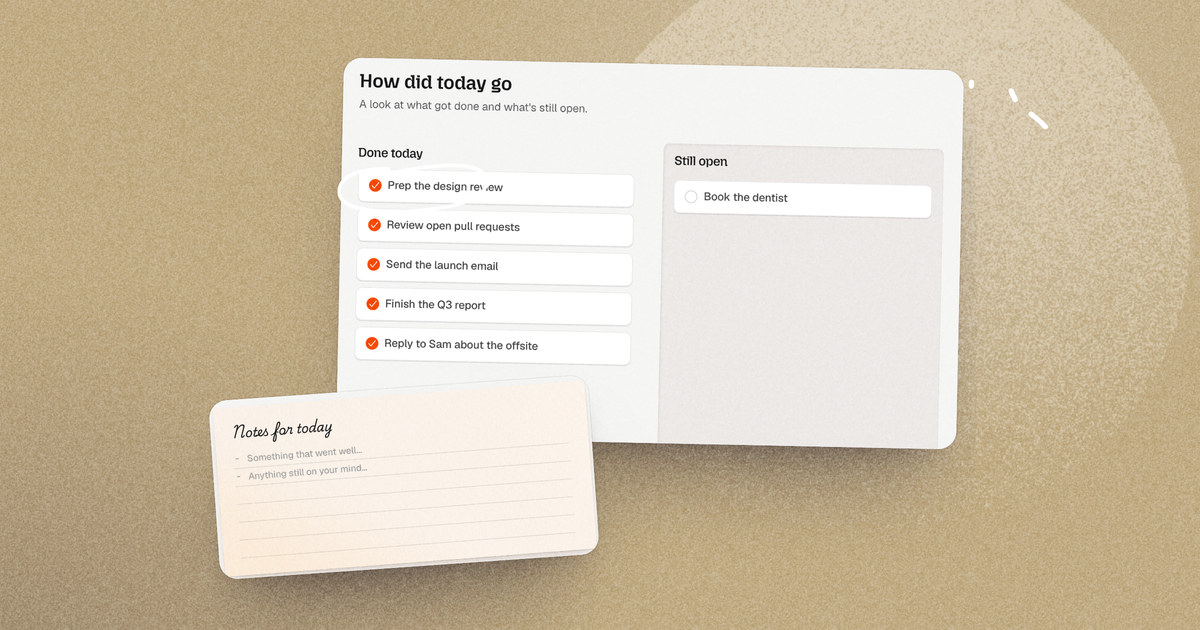
Look at today’s list and separate it into two piles: done and still open. That’s it. No scoring, no productivity ratio, no guilt math about what percentage you “hit.”
This step does two things:
- Seeing the done pile gives you the small hit of closure your brain has been waiting for all day, because completed loops finally get to close.
- It surfaces the open items deliberately, on your terms, instead of letting them ambush you at midnight. A task you’ve looked at and acknowledgedis far less sticky than one still hiding in the pile.
Tip: give the open pile one honest last pass. Sometimes a two-minute task is sitting there, tick it off now. The rest moves to step two.
Step 2 — Migrate the rollover (decide where it goes)
Every unfinished task gets a decision, not a delay. This is the heart of the ritual and the part most people skip. “I’ll deal with it tomorrow” is not a decision, it’s the exact vague non-commitment that keeps the Zeigarnik loop spinning.
Instead, sort each open task into one of two homes:
- Continue tomorrow — it genuinely matters and belongs in the next workday. Give it a real place there.
- Backlog / later — it matters, but not now. It goes somewhere you trust you’ll see it again, out of tomorrow’s field of view.
The magic word is specific. “Migrate this to tomorrow morning” closes the loop; “I should get to this soon” does not. Once every open item has a named destination, there is nothing left for your brain to hold open. That’s the moment the mental tension actually drops.
Step 3 — Sign off (trigger the clean break)
Finally, a deliberate, physical end signal. Humans need a boundary marker to switch modes — the commute used to do this for us, and remote work quietly deleted it. So you have to recreate it on purpose.
A good sign-off has three ingredients:
- A one-line reflection — a single sentence on how the day went or one thing worth remembering. This converts a day of scattered effort into a closed chapter.
- A clear “done” action — one distinct button, phrase, or gesture that means work is over. Say it out loud, hit the button, close the machine.
- A visible state change — the workspace should look closed. Dimmed, put away, shut. Your environment should confirm what your brain just decided.
That combination of [ reflect, declare, see it change ] is what tells the nervous system the transition is real. Now the evening is yours.
How Dayplan simplifies the Shutdown Ritual in Under 5 Minutes
Frameworks are easy to admire and hard to sustain. The reason most people abandon a shutdown ritual isn’t that it doesn’t work, it’s the friction of running it manually every night. We've all been there.
Dayplan builds the entire three-step ritual into a single guided flow at the end of your day, so the habit runs on rails.
It maps one-to-one onto the framework above:
- Review — “How did today go?”
Dayplan splits your day into two clean columns: Done today and Still open. You get a last-pass tick-off for anything you actually finished, and a neutral total of time spent — no productivity score, no completion ratio, nothing designed to make you feel behind. Just an honest picture of the day so the loops can close. - Decide — “Where does the rest go?”
Every still-open task gets dragged into one of two folders: Continue tomorrow or Send to Backlog. This is intention-offloading made physical. Here’s the subtle part that makes it calming rather than lossy: when you carry a task over, Dayplan doesn’t silently reschedule it or bury it. Tomorrow it resurfaces in your day-in-review wearing a soft “From yesterday” badge — so the task you deferred shows up with its history intact, visibly, on purpose. Nothing disappears into a void; nothing gets moved behind your back. You deferred it, you’ll see it, and you know exactly why it’s there. That visible provenance — a gentle memory aid, not an alarm — is what makes it safe to let go tonight. - Close — “Close out”
The final screen gives you a short summary of the day and a space for a quick note. Here, you can reflect on your day, or write a single line for tomorrow-you. Then one deliberate Shut down button. When you press it, Dayplan doesn’t just log the event: your day view visibly dims and washes into a calm, closed state with a banner: “You’ve shut down for today. See you tomorrow.” Work is now clearly, obviously over; new captures quietly route to your Inbox instead of today, and there’s a Reopen option if you genuinely need it, but no pressure to. The environment changes so your brain can too.
Or just tell the Dayplan Coach you’re done.
If opening the app is one step too many at the end of a long day, you can run the entire ritual by chat. Dayplan Coach is an AI assistant that lives in the app and over iMessage, so you can literally text “let’s shut down” from the couch.
The Coach walks you through the same three moves conversationally: it reflects back what you finished, asks where your open tasks should go, carries them over or backlogs them for you, and records the sign-off.
The whole thing takes a few minutes, runs the same way every night, and turns a psychological principle into muscle memory. That’s the difference between knowing about the Zeigarnik effect and actually being free of it.
The Takeaway
You don’t disconnect from work by trying harder to relax. You disconnect by giving your brain proof that everything is handled: every finished task acknowledged, every open task assigned a home, and a clear signal that the day is genuinely over. Clarity, peace, finally.
That’s a five-minute ritual, not a personality change. Clear the queue. Migrate the rollover. Sign off. Do it tonight, and notice how much quieter 11 p.m. gets.
Frequently asked questions
An evening shutdown ritual is a brief, repeatable routine at the end of the workday (typically under five minutes) where you review completed tasks, assign a specific home to unfinished ones, and consciously mark work as “done” for the day. It’s designed to stop work thoughts from intruding on your evening.
Usually because of the Zeigarnik effect: your brain keeps unfinished tasks in an active, unresolved state and replays them until they’re either completed or deliberately deferred. Vague intentions (“I’ll get to it”) don’t release the loop; only a specific plan for when and where you’ll handle the task does.
While you can execute a shutdown ritual using paper or a physical notebook, friction is the main reason the habit breaks down. Guided productivity tools like Dayplan automate the 3-step framework into a single 5-minute end-of-day flow: handling queue reviews, task roll-overs, and visual sign-offs automatically so the routine runs on rails.
Five minutes or less; If it takes twenty minutes, you won't keep it up. Using a manual checklist or a guided tool like Dayplan keeps the process strictly capped under five minutes. The value comes from doing it every day, so it has to be short enough to survive tired, busy, and unmotivated evenings. If it takes twenty minutes, you won’t keep it up.
No, and this is the key insight. You don’t need to complete an unfinished task to quiet it. You only need to give it a trusted, specific destination (tomorrow, or a backlog you’ll actually revisit). The brain releases the loop once it trusts the plan.
What’s the difference between a morning reset and an evening shutdown? A morning reset points your attention at what matters today. An evening shutdown gives your brain permission to stop. One opens the workday cleanly; the other closes it. Run both and the day has a real beginning and a real end instead of bleeding into your personal time.
References
- Zeigarnik, B. (1927). Über das Behalten von erledigten und unerledigten Handlungen [On the retention of completed and uncompleted actions]. Psychologische Forschung, 9(1), 1–85. English translation: Zeigarnik, B. (1938). On finished and unfinished tasks. In W. D. Ellis (Ed.), A source book of Gestalt psychology (pp. 300–314). Kegan Paul, Trench, Trubner & Company.
- Masicampo, E. J., & Baumeister, R. F. (2011). Consider it done! Plan making can eliminate the cognitive effects of unfulfilled goals. Journal of Personality and Social Psychology, 101(4), 667–683.