
TL;DR: Stopping work is not the same as resting. When you scroll on a break, your attention keeps working: processing images, opinions, alerts, and social cues. This means that an already-tired mind never gets the low-demand pause it needs. Research finds that phone breaks can leave you performing about as poorly as taking no break at all. The fix isn’t willpower; it’s choosing lower-input recovery on purpose and building it into your day before you’re desperate.
The modern workday feels louder, faster, and more urgent than the one it replaced. Messages arrive while you work. Notifications interrupt a thought the moment it forms. Every task is one of a dozen.
So we feel like we need breaks more often, and we get overwhelmed more easily. Yet real breaks keep getting harder to take. By mid-afternoon, even simple decisions feel expensive, and instead of stepping away, we reach for a phone.
We open Instagram while a document loads. We check TikTok or Reels between meetings, or we skim Reddit over lunch, while brushing our teeth, and waiting for the ride to arrive. We tell ourselves we’re taking five minutes to switch off, and spend those minutes scrolling, only to return distracted, restless, or more tired than before.
That’s because stopping work is not the same as taking a break and recharging.
Social media offers a temporary escape from a hard task, but it keeps feeding your brain new information, emotional cues, decisions, and interruptions. It changes what you pay attention to without giving your attention a chance to recover. A real break reduces the demands on your mind. A scrolling break often just swaps one set of demands for another.
Why don’t social media breaks feel restorative?
Social media breaks frequently fail to recharge you because they keep your attention externally engaged. While scrolling, your brain continually processes new images, captions, opinions, jokes, ads, alerts, and social signals. You may no longer be thinking about work, but your attention is still working.
One experiment with 414 participants found that people who used a phone during a break took 19% longer to finish the remaining task and solved 22% fewer problems than participants in the other break conditions combined. Their performance looked closer to that of people who’d had no break at all (Kang & Kurtzberg, 2019).
The lesson isn’t that every interaction with a phone is harmful. It’s that a phone may be a poor recovery tool when your mind is already depleted.
Why do we need breaks in the first place?
Contrary to hustle-culture logic, breaks aren’t interruptions to productive work. They’re part of what makes sustained work possible.
Focused activity draws on limited cognitive resources: you hold information in working memory, ignore distractions, make decisions, monitor progress, and repeatedly redirect your attention toward the task. As mental effort accumulates, it can get harder to concentrate, regulate frustration, weigh priorities, and resist irrelevant distractions. Pushing through doesn’t reliably produce more useful work—sometimes it just produces slower, more error-prone work.
Recovery restores a rhythm between effort and release:
Focus → fatigue → recovery → renewed capacity
Remove the recovery stage and you don’t become a productivity machine; you usually make the next stretch of focus less effective.
And “resting” isn’t the same as “doing nothing useful.” Researchers studying the brain’s default mode network (DMN), the internally oriented systems that become more active during wakeful rest and mind-wandering, have challenged the idea that an idle mind is idle at all.
During rest, these systems are involved in memory, reflection, meaning-making, and thinking beyond the immediate moment (Immordino-Yang, Christodoulou & Singh, 2012).
Rest, in other words, is not empty time.
Why do we automatically reach for social media?
Most of us don’t choose social media because we’ve carefully decided it’s the most restorative option. In fact, we may have realised it is the opposite. But we choose it because it’s immediate. A demanding stretch of work depletes your cognitive reserve, and your brain reaches for effortless, high-novelty relief.
The catch: rapid, algorithmic feeds force you to keep processing new contexts, tone shifts, and visual stimuli. So you never actually drop into a restorative state.
Four pulls make the phone the default:
- It asks almost nothing from you. Opening an app is easier than deciding what kind of break you need. Your phone is already beside you.
- It promises instant novelty. Work can be repetitive or uncertain. A feed promises something new with every swipe. The next interesting thing always feels one scroll away.
- It creates a feeling of connection. Much work is solitary. Feeds are full of faces, reactions, and signs of other lives, which can feel appealing even when the interaction is shallow.
- It removes the uncomfortable transition between tasks. A natural pause can hold boredom, mental noise, or uncertainty about what’s next. A phone fills that space instantly, but the space itself may be part of the recovery. When every quiet moment is filled with content, your mind gets fewer chances to wander, settle, and process what just happened.
Why phone breaks are often “fake rest”
A fake break stops the original task but preserves the state of stimulation that made you need a break. You leave the spreadsheet, but start reading comments. You close the inbox, but begin processing messages. You step away from a hard decision, but expose yourself to dozens of new emotional and informational signals. The content changed. The attentional demand didn’t.
Here’s why scrolling so often backfires:
Your attention keeps switching. A feed can move from a friend’s holiday to breaking news to a productivity tip to an ad to a political argument to a funny clip in seconds. Each item asks your brain to reorient. It feels effortless because the platform supplies the next stimulus automatically, but effortless consumption isn’t the same as cognitive rest.
Your brain keeps processing input. Scrolling means reading, interpreting, comparing, anticipating, and deciding whether to stop. Even entertaining material is still input. Real recovery usually means reducing input.
Your mind can’t fully wander. Periods of low external demand let thoughts surface without an algorithm directing them: the internally focused state linked to reflection, memory integration, and creative thought. The DMN tends to become more active during rest and less dominant during externally focused tasks (Luo et al., 2024). You don’t need neuroscience to notice the practical difference: ideas tend to arrive in the shower, on a walk, or while staring out a window—not mid-scroll.
The phone can stay mentally “loud” even when idle. Research on the “brain drain” hypothesis found that the mere presence of your own smartphone can reduce available cognitive capacity (even when you aren’t using it!) because resisting the device may consume some limited attention (Ward et al., 2017). This doesn’t mean a visible phone ruins every session, but putting physical distance between you and it can make a break more complete.
You may come back with attentional whiplash. A good break should make returning to work easier. Social media can do the opposite: after minutes of rapid novelty, a slow, difficult task feels even less stimulating by comparison. So the report, budget, or study session feels unusually uncomfortable to restart.
The result is a familiar loop:
- Work starts to feel difficult.
- You check your phone for relief.
- The phone increases stimulation and fragmentation.
- Work feels even duller when you return.
- You want another phone break sooner.
Real rest vs. fake rest
The distinction isn’t simply “screens bad, offline good.” It’s whether the activity reduces the type of demand that depleted you.
- Fake rest distracts you from fatigue while continuing to consume attention.
- Real rest lowers cognitive, emotional, or physical demand long enough for some capacity to return.
| Fake rest | Real rest |
|---|---|
| Automatically opening a feed | Deliberately choosing a break activity |
| Consuming rapid, unpredictable content | Reducing incoming information |
| Staying in the same posture and place | Changing position or location |
| Filling every quiet second | Allowing boredom or mind-wandering |
| Losing track of time | Starting and ending on purpose |
| Feeling more scattered afterward | Feeling calmer, clearer, or more awake |
The same activity won’t work for everyone. A short conversation might restore someone who’s worked alone for hours, but drain someone who’s spent the day in meetings. So the useful question isn’t “Is this activity generally relaxing?” It’s:
“What kind of recovery does my current state need?”
Passive distraction vs. active recovery
Most productivity systems treat a break as an empty gap. You stop working, but there’s no clear alternative, and because your phone is the easiest source of stimulation, the empty gap quickly becomes scrolling time.
Active recovery is a break deliberately chosen to counter the demands of the work you just did. “Active” means intentional, not effortful, and although the name sounds like it, it doesn’t have to involve exercise:
- After mentally demanding work: close your eyes, make tea, take a quiet walk, look outside.
- After long, sedentary work: stretch, walk around the room, get fresh air.
- After isolating work: talk to someone you care about.
- After a day of meetings: ten minutes without speaking, listening, or responding to anyone.
| Dimension | Passive distraction (fake rest) | Active recovery (real rest) |
|---|---|---|
| Core mechanism | Input-heavy screen consumption (feeds, news) | Low-stimulation offline movement, stillness, or breath |
| Brain state | High cognitive load; suppressed default mode network | Low cognitive load; mind-wandering and creative integration |
| Post-break feeling | Context whiplash, eye strain, lingering guilt | Mental clarity, less tension, renewed focus |
| Structure | Porous micro-breaks that bleed into work time | Intentional, scheduled offline boundaries |
Why Traditional Planners Fail at Energy Pacing
Traditional planners begin with a familiar question: What do you want to achieve today? You add meetings, errands, deadlines, and priorities until the screen holds a long list of obligations. This output-centric approach ignores how human focus actually operates.
Instead of pushing through fatigue until you crash, Dayplan uses Energy Pacing, the continuous management of cognitive bandwidth across the workday to prevent burnout before it happens.
Traditional planners rarely ask:
- When will you recover?
- What kind of break will help after this task?
- How much focused work can reasonably fit into this day?
- What will you do when your energy drops?
And when every visible item is unfinished work, stopping feels irresponsible. You sit in front of a list of unchecked tasks, and even a necessary pause produces guilt. You technically have time to rest, but the system has framed rest as avoidance.
Most systems fail at energy pacing because they treat recovery as leftover time. By forcing you to squeeze rest into accidental gaps, they fail to adopt Break-First Planning, a model where intentional downtime is scheduled before task blocks are locked in.
A realistic plan should account for the person doing the work, not only the work itself.
How Dayplan helps you rest, so you can do more
The "Passive Break" vs. "Active Recovery" Contrast
Most apps treat a break as an empty gap where you stare at your phone. Dayplan treats breaks as an active component of your day. By scheduling hard, intentional break blocks, Dayplan gives you permission to step completely away from your desk, so your brain actually gets the offline downtime it needs to reset.
Built on this philosophy, Dayplan introduces Break-First Planning: the methodology of scheduling non-negotiable recovery blocks on your calendar before mapping out output tasks. Instead of treating rest as leftover time, Dayplan assumes that a realistic day is made from focus, effort, transitions, and recovery, not tasks alone.
Breaks are built into planning
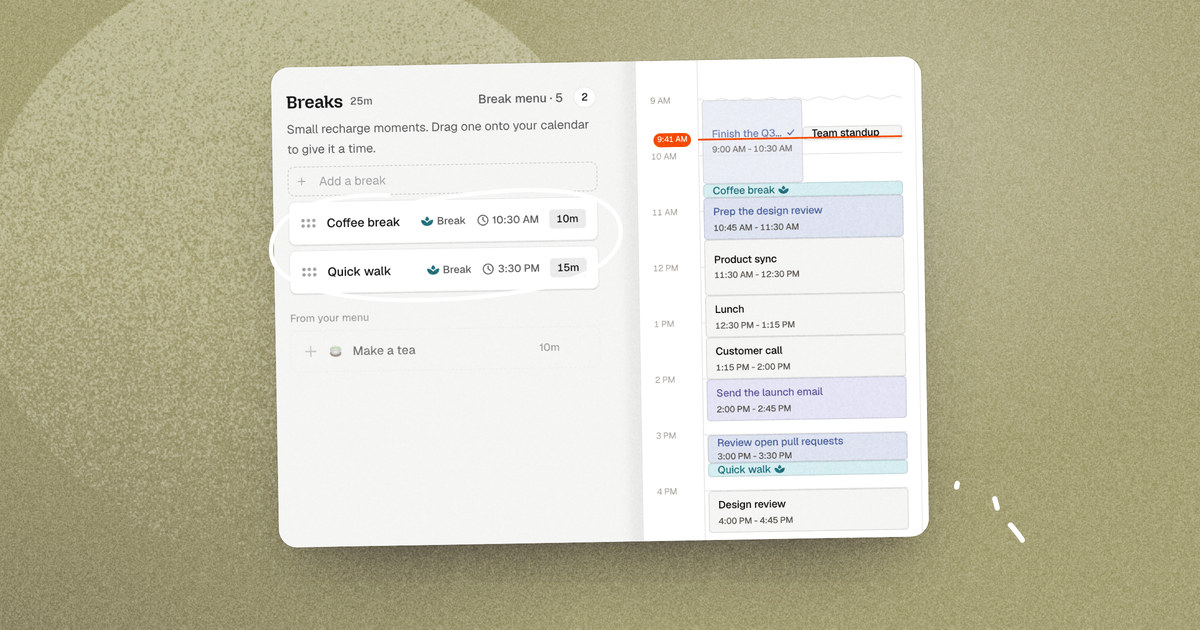
In Dayplan’s Plan Today flow, you add breaks right alongside your tasks and commitments, in a dedicated Breaks section (“Small recharge moments”). This lets you see your day as a sequence of effort and recovery, not one uninterrupted list of things you should be doing. Breaks are a distinct kind of block, not disguised tasks, so recovery is visible in the same plan as your work.
You can build your own break menu
Dayplan lets you save the breaks that genuinely work for you into a personal Break menu. This is Dayplan’s take on the dopamenu idea, organized like a restaurant menu (Starters, Mains, Desserts) and filterable by how much time you have. Instead of defaulting to your phone, you pick from a menu you curated while you were rested.
Can’t decide? A “Surprise me” option picks one for you.
The coach nudges you before you burn out
Dayplan’s coach watches for the pattern that precedes a doom-scroll: sustained work underway with no timed break coming up. When it sees it, it sends a gentle break nudge “you’ve been at it a while; stretch for 3 minutes?”, rather than waiting for you to crash.
It’s plan-aware and capped so it stays a nudge, not nagging, and you can turn it off anytime.
Give a break a real time on your calendar
A break in Dayplan starts life off the calendar—no slot is booked until you choose one. Drag it onto your day (or tap a suggested time) to turn it into a protected, timed block. A scheduled break isn’t an accidental blank space; it’s an intentional block with a purpose. And when recovery is represented in the same plan as your work, it stops looking like a failure to follow the plan, it becomes part of following it.
Most productivity apps organize what you need to do. Dayplan also helps you protect the person who has to do it, because a realistic day needs enough space to be human.
Most productivity apps organize what you need to do. Dayplan also helps you protect the person who has to do it, because a realistic day needs enough space to be human.
How to take downtime that actually recharges your brain
1. Decide what the break is for
Before reaching for your phone, name what feels depleted: foggy, stiff, frustrated, lonely, overstimulated, bored? Matching the break to the need makes it far more likely to help:
- Mental fatigue: sit quietly, walk without audio, look outside.
- Physical fatigue from sitting: stretch or take a short walk.
- Overstimulation: choose silence, close your eyes, move to a quieter room.
- Low energy: get daylight, water, movement, or fresh air.
- Social isolation: talk to a real person rather than consuming updates about strangers.
- Emotional frustration: journal briefly, breathe slowly, change environments.
2. Put physical distance between you and your phone
A break is easier to protect when the phone isn’t in your hand. Leave it on the desk while you make tea. Put it in a drawer. Charge it across the room. Walk for five minutes without it. The goal isn’t perfect digital discipline, because perfection is impossible. It’s removing the need to resist the device for the whole break.
3. Reduce incoming information
Most restorative activities share one trait: they don’t supply a constant stream of new input. Try looking out a window, walking without a podcast, stretching, making a drink, watering a plant, closing your eyes, sitting outside, doodling, breathing slowly, or listening to one familiar song and nothing else. These can feel boring at first, but that is fine, because boredom is often the transition between stimulation and rest.
4. Build a “dopamenu” of better breaks
When you’re already tired, inventing a restorative activity feels like another task. So decide in advance. A “dopamenu”— a concept popularized in the ADHD community — is a personal menu of quick, enjoyable, low-effort activities you can pick from without deliberating. Organize it by time or by need:
- Two minutes: drink water · stretch your shoulders · look outside · take ten slow breaths
- Five minutes: walk around the room · make tea · stand outside · doodle on paper
- Ten to fifteen minutes: take a phone-free walk · lie down with eyes closed · have a real conversation · do a short mobility routine
A prepared menu gives you an easy alternative the moment your automatic impulse is to scroll.
5. Schedule breaks before you feel desperate
When you wait until you’re completely spent, the most stimulating option usually wins. Place breaks between demanding blocks rather than treating them as rewards to be earned after everything’s done. A scheduled break also reduces guilt, because it’s no longer an impulsive escape from your plan; it is the plan.
6. Give the break a clear boundary
An intentional break has a beginning and an end. Pick an approximate duration before you start. For example, five minutes may be plenty after a short focus block; longer after hours of demanding work. The point isn’t to optimize every minute! A boundary simply keeps a brief pause from becoming thirty minutes of unconscious scrolling.
7. Notice how you feel afterward
The best test of a break isn’t whether it felt pleasurable in the moment. Ask: Do I feel calmer? Is my attention less scattered? Does my body feel better? Can I return to the next task more easily? Do I feel restored, or merely distracted? A break that consistently leaves you more restless may not be a useful break for you, even if it’s entertaining.
8. Stop treating rest as something you must earn
You’re not a machine, and rest isn’t a prize reserved for people who’ve finished every task. You need recovery because you’re a person with a nervous system, a body, limited attention, and changing energy, not merely because resting might make you more productive afterward, or something you have to work hard to earn.
Rest can support better work. But your right to pause doesn’t depend on how much work the pause helps you produce.
Key takeaway
When you need a break, you don’t always need more interesting content. Sometimes you need less input.
Put down the phone. Let the next few minutes be uneventful. Walk, stretch, stare outside, make tea, or simply let your mind go somewhere an algorithm didn’t choose. The quiet may feel unfamiliar at first.
That might be exactly why you need it.
This article is for general educational purposes and describes non-clinical strategies for everyday rest and focus. It is not medical or psychological advice and isn’t a substitute for care from a qualified professional. Persistent fatigue, burnout, low mood, anxiety, or difficulty concentrating can have medical causes if these affect your daily life, please consult a licensed clinician.
Frequently asked questions
Energy Pacing is the practice of continuously managing mental bandwidth across the workday by alternating focused effort with low-stimulation recovery blocks to prevent cognitive exhaustion before it happens.
Scrolling can provide temporary distraction or entertainment, but it isn’t always cognitively restorative. Social media keeps supplying external information and rapid attentional shifts, so it may not give an already-tired mind the lower-demand period it needs.
Real rest reduces the demands responsible for your fatigue. Fake rest changes the activity but keeps consuming the same resources. For example, switching from a demanding document to an information-heavy feed stops the task without resting your attention.
Helpful breaks from screen work often involve physical movement, a change of environment, distance from screens, and less information intake: walking, stretching, looking outside, making a drink, sitting quietly, and briefly closing your eyes.
There’s no universally "correct" length. Even a few intentional minutes can interrupt prolonged effort, while deeper fatigue may need longer. The quality of the break, especially whether it lowers stimulation, can matter as much as its duration.
A dopamenu is a personal, pre-made menu of quick, enjoyable, low-effort activities you can choose from when you need a break or a lift, so you don’t have to invent one while depleted. Deciding your options in advance makes it easier to pick genuine recovery over an automatic scroll.
Break guilt often comes from treating rest as the opposite of progress. Long task lists and productivity systems reinforce it by keeping unfinished work visible while leaving recovery invisible. Scheduling breaks in advance helps frame them as a legitimate part of the day.
Not necessarily. Phones can support useful or enjoyable activities. The key question is whether your use helps you recover or adds more stimulation. When your attention is tired, a brief period without the phone is often a better experiment than automatically opening a feed.
Scientific sources & further reading
- Immordino-Yang, M. H., Christodoulou, J. A., & Singh, V. (2012). Rest is not idleness: Implications of the brain’s default mode for human development and education. Perspectives on Psychological Science, 7(4), 352–364. https://doi.org/10.1177/1745691612447308
- Kang, S., & Kurtzberg, T. R. (2019). Reach for your cell phone at your own risk: The cognitive costs of media choice for breaks. Journal of Behavioral Addictions, 8(3), 395–403. https://doi.org/10.1556/2006.8.2019.21
- Luo, W., Liu, B., Tang, Y., Huang, J., & Wu, J. (2024). Rest to promote learning: A brain default mode network perspective. Behavioral Sciences, 14(4), 349. https://doi.org/10.3390/bs14040349
- Ward, A. F., Duke, K., Gneezy, A., & Bos, M. W. (2017). *Brain drain: The mere presence of one’s own smartphone reduces available cognitive capacity.*Journal of the Association for Consumer Research, 2(2), 140–154. https://doi.org/10.1086/691462