
You know the feeling: the task is right there on your list. You even want it done. But something in your brain won’t let you start, although you have tried. So you refresh your inbox, reorganize a folder, or just sit there while the weight of the undone thing grows heavier.
That’s task initiation paralysis: the gap between knowing what to do and being able to begin. It’s especially common for people with ADHD, executive-function differences, burnout, or anyone running on low motivation. It comes with the cruel downside that the harder you push yourself, the more shame builds up if you don’t do the task, and shame makes attempting even harder.
It is not a willpower issue; so more “wanting” to get it done does not fix it. A better approach to tackling the task does. That’s exactly what an AI accountability coach is built for: to help you decide on the first step, and to get the ball rolling.
What is an AI accountability coach?
An AI accountability coach is a conversational assistant powered by artificial intelligence that helps you move from intention to action.
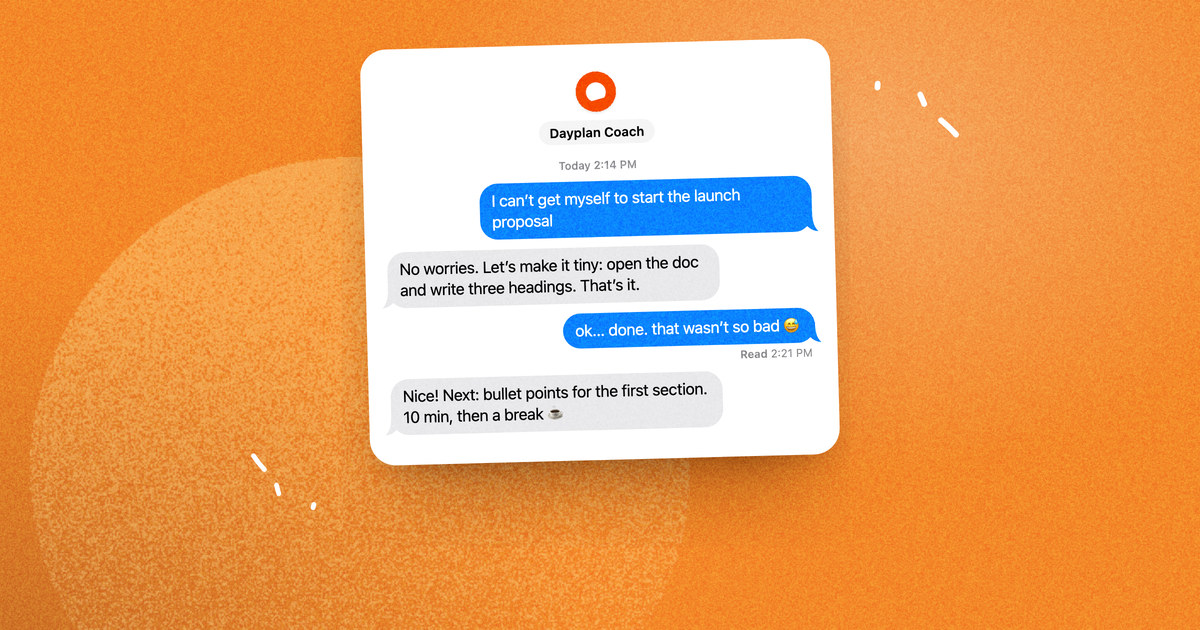
In Dayplan, the Coach is available right inside your planner and over iMessage, so it meets you where you already are. It actively tracks your tasks and your plan for the day, checks in with you, and helps you actually get moving on your plans regardless if you think a task is too big or too intimidating.
It helps by shrinking the task in front of you until starting feels possible. So instead of a static to-do list that silently judges you, it’s a back-and-forth partner that asks, “What’s the very next thing you could do to complete this?” and helps you answer.
Similar to a human accountability coach, the Dayplan coach helps you break down goals, provide check-ins, and help you overcome whatever setbacks you encounter on your way.
Why task initiation paralysis happens
Understanding the mechanism is what makes the fix work:
- The task is too big to hold in your head. “Do taxes” isn’t a task, although most planners treat it as such. It’s a project wearing a task’s clothes, with many scattered, smaller sub-tasks to do. Your brain can’t find the entry point, so it stalls.
- The next action is ambiguous. When the first step is undefined, starting requires making decisions before you can even begin. That’s two hard things stacked on one.
- Emotional friction outweighs the reward. Low motivation, anxiety, or dread attaches to the task. The list can’t argue back, but a coach can remind you and help you get overcome this emotional friction, and actually get the thing done.
- No external momentum. Alone with a checklist, there’s nothing to catch you when you drift. You can keep ignoring it for a while, and the task gets deferred to tomorrow every day until the deadline.
An AI coach attacks all four: it decomposes, clarifies, defuses, and provides gentle momentum.
How conversational micro-steps break the freeze
The core move is simple and research-backed: make the first step so small it’s almost silly to refuse. Dayplan’s Coach does this through conversation.
Researchers who study behavior change have a rule of thumb: when a behavior isn’t happening, don’t try to pump up motivation, make the action easier. Motivation is fickle; ease is reliable. So when you tell Dayplan’s Coach you’re stuck, it doesn’t reply with a pep talk. It breaks the task into concrete, doable micro-steps and hands you one to start with. “Write the report” becomes “Open a blank doc and type the title.”
Once you’ve done the first ten-second action, the wall is gone, and momentum starts building fast, and this is because that tiny first action is doing more work than it looks. Psychologists have known since the 1920s that once you start something, your brain won’t quite let it go. It wants to close the loop. A started-but-unfinished task nags at you until it’s done.
It’s why the hardest part is almost always beginning; cross that line and momentum carries you. The Coach’s whole job is to get you across it.
There’s a reason the next step has to be that specific, too. The most reliable predictor of whether you’ll actually follow through isn’t how much you want to; we all know there are tasks we really want to do, but we can’t.
It’s whether you’ve pinned down when, where, and how. Across 94 studies, simply spelling that out produced a large jump in follow-through. A vague “work on the report” stalls; “open the doc now” gets done.
Crucially, it’s judgment-free by design. If your motivation dropped and yesterday’s plan didn’t happen, the Coach doesn’t scold you or make the miss loud. It helps you re-decide and recommit, then rebuilds a realistic version of today.
The point is to lower the emotional cost of starting again, because the fastest way back to productivity is not feeling bad about the gap. It is about forgiving yourself for not doing it in the past, which is what actually gets you back to work fastest.
Things you can actually ask the Dayplan Coach
Here’s where an accountability coach becomes concrete. These are real requests you can make of Dayplan’s Coach in plain language, by typing, or by voice:
| Situation | Ask | What Coach does |
|---|---|---|
| When a task feels too big | “Break down ‘launch the newsletter’ into steps. I really don’t feel like doing it” | The Coach splits it into a sequence of small, doable actions and turns them into subtasks you can check off one at a time. |
| When you don’t know where to start: | “I’m stuck and a bit overwhelmed. What should I do first? ” | It looks at your day and hands you a single, low-friction next action instead of the whole overwhelming pile. |
| When you can’t find the time: | “Find me 30 minutes for deep work this afternoon.” | The Coach scans your calendar for a real open slot and timeboxes the task into it, so “later” becomes an actual time on the clock. |
| When you’re starting your day | “Help me plan today.” | Dayplan’s guided first-plan flow walks you through a brain-dump, then helps you assign durations, timebox tasks, and, importantly, schedule breaks, so your day is humane instead of a wall of work. |
| When you need a nudge to follow through | “Remind me to email Andreea at 2pm.” | It sets the reminder and follows up, giving you the external accountability that a silent list can’t. |
| When motivation is gone entirely | “I only have energy for one thing today. What can I do that matters most?” | The Coach helps you pick your non-negotiable and lets the rest wait, protecting momentum instead of demanding heroics when you are already too tired. |
| At the end of the day | “Let’s shutdown for today.” | It walks you through what got done, asks what should carry over for tomorrow or into next week, and closes the day cleanly, so tomorrow starts with clarity instead of dread. |
Why “conversational” matters more than “automated”
Plenty of apps will auto-schedule your tasks, but that’s not the same as helping you start them. Task initiation paralysis is an emotional and cognitive problem, not a logistics one, so the solution has to feel like a conversation, not a command line.
Because Dayplan’s Coach talks with you, it can:
- Meet a drop in motivation with a smaller ask instead of a rigid plan.
- Surface things gently, with context: never moving your tasks around invisibly, so you always feel in control rather than managed.
- Adapt in the moment: reschedule, break down, or trim the day based on how you actually feel right now.
That responsiveness is what turns “I can’t start” into “okay, I did the first thing.” This gives you a boost of momentum and motivation for the day.
Who benefits most
- People with executive-function challenges, where the initiation gap is not a matter of trying harder.
- Anyone in burnout or recovery, where low-energy days need a coach that scales the plan down, not up.
- Chronic procrastinators who have the skills but freeze at the starting line.
- Anyone whose to-do list has quietly become a source of guilt instead of a tool.
The bottom line
Task initiation paralysis isn’t a character flaw, although some of us can end up feeling like it is. It’s a predictable gap between a task that’s too big and a first step that’s too vague. An AI accountability coach closes that gap by shrinking the task into a conversational micro-step you can’t reasonably refuse, and it does it without judgment, which is exactly what makes starting again feel safe.
Dayplan’s Coach lives inside your planner and over iMessage, ready to break down what’s overwhelming, find the time, nudge you forward, and help you recommit when a day slips. You don’t need more willpower. You need a better next step, and something that will hand it to you.
Ready to beat the freeze?
Sign up to our private beta to try Dayplan, and let the Coach help you take the first step.
Dayplan is a productivity assistant, not a medical device or a substitute for professional care. The Coach is designed to help you plan and get unstuck on everyday tasks; it does not diagnose, treat, or provide therapy for ADHD, executive-function conditions, burnout, or any other health condition. If task initiation paralysis is significantly affecting your wellbeing, please consult a qualified healthcare or mental-health professional.
References
Fogg, B.J. (2019). Tiny Habits: The Small Changes That Change Everything. Houghton Mifflin Harcourt. — Behavior = Motivation × Ability × Prompt (B=MAP); increasing ability (making the first step easier) is more reliable than boosting motivation. (Model first published 2009; expanded in the 2019 book.)
Gollwitzer, P.M., & Sheeran, P. (2006). “Implementation Intentions and Goal Achievement: A Meta-Analysis of Effects and Processes.” Advances in Experimental Social Psychology, 38, 69–119. — Specifying when/where/how yields a medium-to-large effect (d = .65) across 94 independent tests.
Jacobson, N.S. et al. (1996), Journal of Consulting and Clinical Psychology, & **Dimidjian, S. et al. (2006).**Foundational trials of Behavioral Activation — structured small actions restore motivation; action precedes motivation.
Zeigarnik, B. (1927). “Über das Behalten erledigter und unerledigter Handlungen” [On the retention of completed and unfinished actions]. Psychologische Forschung, 9, 1–85. — The Zeigarnik effect.
Ovsiankina, M. (1928). “Die Wiederaufnahme unterbrochener Handlungen” [The Resumption of Interrupted Actions]. — The Ovsiankina effect: the pull to resume a started task.
Sirois, F.M. (2014). “Procrastination and Stress: Exploring the Role of Self-Compassion.” Self and Identity, 13(2), 128–145.
Wohl, M.J.A., Pychyl, T.A., & Bennett, S.H. (2010). “I forgive myself, now I can study: How self-forgiveness for procrastinating can reduce future procrastination.” Personality and Individual Differences, 48(7), 803–808.
Frequently asked questions
Task initiation paralysis is the gap between knowing what you need to do and being able to actually start it. The task is defined, you may even want it done, but you can’t cross the line into beginning. It’s common with executive-function differences, burnout, and low-motivation states, and it’s a wiring-and-emotion problem, not a discipline problem.
An AI accountability coach shrinks the task in front of you until starting feels possible, then gives you gentle momentum to keep going. Instead of a static list that silently judges you, it’s a conversation: it breaks big tasks into small next actions, helps you schedule them into real time, and nudges you to follow through; without shame when a day slips.
Dayplan’s Coach is a conversational AI assistant built into the Dayplan planner, and available over iMessage, that helps you move from intention to action. You can ask it in plain language — by typing or by voice — to break down a task, find time on your calendar, set reminders, plan your day, or help you recommit when motivation drops.
You can ask things like: “Break down launch the newsletter into steps,” “I’m stuck, what should I do first?,” “Find me 30 minutes for deep work this afternoon,” “Remind me to email Andreea at 2pm,” “Help me plan today,” or “I only have energy for one thing today, what matters most?” The Coach responds with concrete next actions instead of pressure.
Behavioral science consistently finds that making an action easier is more reliable than trying to feel more motivated. A tiny first step, such as “open a blank doc and type the title”, drops below the threshold where motivation even matters. And once you’ve started, the pull to keep going takes over, so beginning is the real battle.
No, it’s judgment-free by design. If yesterday’s plan didn’t happen, the Coach helps you re-decide and rebuild a realistic version of today rather than making the miss loud. This is intentional: research shows self-criticism makes procrastination worse, while self-compassion helps you get back to work faster.
It’s especially useful for ADHD and other executive-function challenges, where task initiation is a genuine neurological hurdle rather than a matter of trying harder. Dayplan’s Coach handles the two hardest parts for an ADHD brain: breaking a vague task into a concrete next step, and putting it into a specific time, on your behalf. Dayplan is a productivity assistant, not a medical device or a substitute for professional care. The Coach is designed to help you plan and get unstuck on everyday tasks; it does not diagnose, treat, or provide therapy for ADHD, executive-function conditions, burnout, or any other health condition.
Auto-scheduling solves logistics; it doesn’t help you start. Task initiation paralysis is emotional and cognitive, so the fix has to feel like a conversation, not a command. Because Dayplan’s Coach talks with you, it can meet a drop in motivation with a smaller ask, surface things gently with context, and never move your tasks around invisibly.